
Aaron Wright and Nate Justiss have been solving problems together since childhood — even before they knew what design or construction meant.

The two first met in elementary school, bonded through years of playing soccer, then reconnected at Auburn University as roommates, where their friendship deepened alongside the foundations of two successful careers.
Today, Wright ’03 ’04, who earned both a bachelor’s and master’s degree from the McWhorter School of Building Science (BSCI), is the founder of The Construction Channel, a 24-hour media network highlighting news, markets, materials and people in the construction industry. Justiss, a 2005 Industrial Design graduate of the School of Industrial and Graphic Design (SIGD), is founder of Distil Union, an award-winning product design company known for its inventive consumer products.

Though their paths diverged professionally, both credit Auburn with preparing them to think differently, work collaboratively and pursue ideas with persistence.
For Wright, the Building Science program offered a practical path that aligned with how he wanted to think—big, he said. What began as a last-minute major change became a defining decision. At Auburn, he embraced a philosophy he still shares with students today: show up.
“Go to every class,” he said. “Try to show up is a philosophy I adopted from that.”
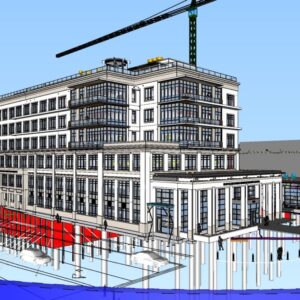
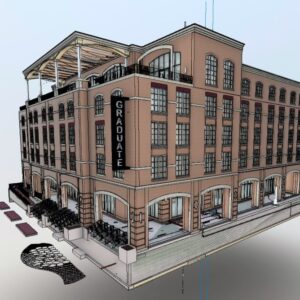
That mindset helped shape a career spanning more than two decades, including pioneering Building Information Modeling (BIM) practices and contributing to more than 200 BIM projects.
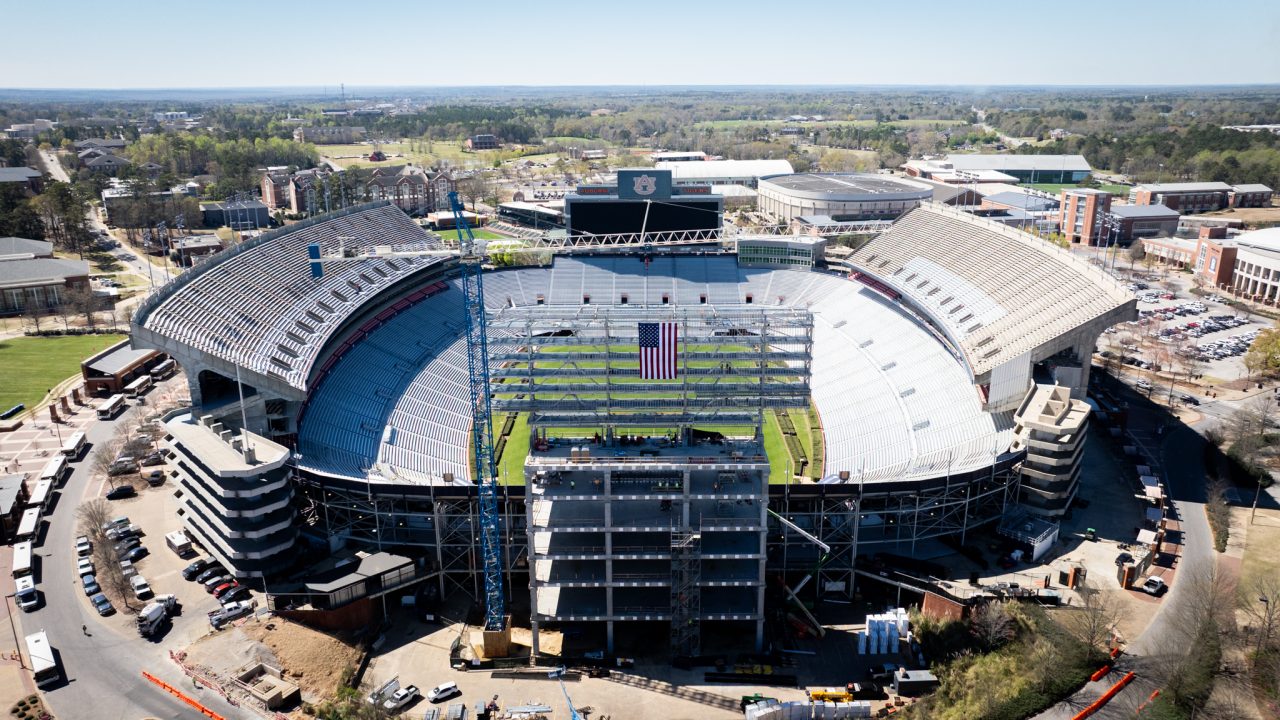
Wright has continued to show up at Auburn, teaching a BIM course in the Civil Engineering program, participating in BSCI steering committees and the Industry Advisory Council and working on about 20 Auburn University construction projects. He said Auburn also taught him teamwork, communication and how to solve problems under pressure. His daughter Addison is continuing in her father’s footsteps and will be a junior in Building Science in the fall.

Justiss began his college education on a marine biology track at the College of Charleston before discovering Auburn’s Industrial Design program during a visit to campus.
“It blew my mind that I could actually go to school to become a designer and inventor,” he said.
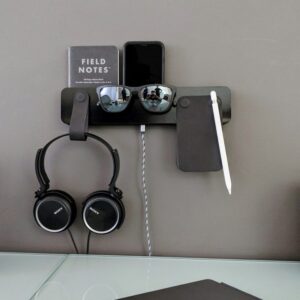
In studio, he developed a rigorous work ethic and learned the importance of questioning assumptions. He said the program’s emphasis on starting with the problem—rather than existing solutions—helped shape how he approaches design today. That perspective has led to multiple patents, international design awards and more than $750,000 in Kickstarter funding for 10 different projects. He credits INDD’s Professional Practice course with teaching lessons in budgeting, freelancing and living beneath his means—practical guidance that gave him confidence to take entrepreneurial risks.


Though they approached problems differently—Wright eager to charge ahead, Justiss inclined to analyze—they see those differences as complementary. Wright has joked that Justiss likes to read the instructions while he prefers to “go straight there,” a contrast that has fueled decades of creative exchange. Their first collaboration came in 2004 when Justiss designed the original logo for Wright’s company the Construction Channel, while the two were roommates. Since then, their collaboration has been less formal but equally meaningful: a decades-long exchange of encouragement, critique and shared ideas.
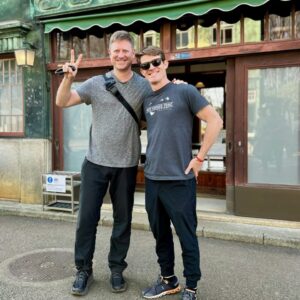


That spirit was renewed earlier this year during a spontaneous trip through Hong Kong, Shenzhen and Tokyo, guided by their self-appointed motto: “No Edits, No Expectations.”
The trip became both reunion and design study. Wright was struck by construction methods and infrastructure at a scale unlike anything he had seen, including dense urban systems built with pedestrians in mind and construction processes that challenged assumptions he brought from American practice. He was also struck by the quiet of cities shaped by electric vehicles and transit.

For Justiss, the trip reinforced the value of observing how other cultures approach design. From Shenzhen’s rapid innovation to Tokyo’s compact, people-centered urbanism, he saw reminders that good design is shaped by culture, constraints and curiosity.
For both, the experience reinforced lessons first sparked at Auburn—stay curious, challenge assumptions and remain open to new ways of thinking—and never let go of the friends made along the way.