
“Coordination chaos” is rarely one dramatic failure. Most of the time it is a steady accumulation of small disconnects: the estimate was built from one set of assumptions, procurement bought from another, the model was updated without regard for the change in quantities, and the field was handed information that was technically correct but out of sequence with what was actually happening on site.
Projects can survive a few disconnects, but they cannot survive disconnect becoming the default operating condition. Chronic disconnect causes the job to start hemorrhaging time in ways that are difficult to track: rework that is labeled as “field adjustment,” RFIs that exist because the latest decision is not visible, and schedule compression attributable to teams constantly catching up to information that should have been aligned earlier.
Connected workflows are often described as a technology trend. In practice, connected workflows are a coordination discipline. They reduce chaos by making sure the project is not operating with multiple versions of the truth at the same time. The payoff is not theoretical. When connected workflows are implemented well, contractors see fewer late surprises, fewer handoff errors, and fewer costly moments where teams discover—too late—that they were not building from the same assumptions.
Chaos comes from drift. When the model, the buyout, and the field aren’t aligned, the job pays for it in churn. “Connected” is just a way of saying: one version of truth.
What coordination chaos actually looks like on real projects
Coordination chaos usually shows up in predictable ways.
One symptom is “everything is urgent.” That happens when teams cannot trust the system to surface issues early, so the job is forced to react late. Another symptom is repeated rework in the same categories: sleeves not aligned to current routing, material ordered to old quantities, prefabrication built to outdated model geometry, or field crews installing based on drawings that do not reflect the latest coordinated decision.
Chaos also shows up as meeting overload. When information is fragmented, alignment requires constant meetings, constant calls, and constant manual reconciliation. People spend more time confirming what is true than executing based on airtight knowledge of what is true.
The costs are real, even when they are not documented cleanly. Time gets lost in re-coordination. Labor gets lost in stop-and-start production. Procurement gets trapped in expediting. PMs lose hours chasing updates. Supers lose confidence in what they are being handed.
Illustrative example: A design change shifts a main run through a corridor. The model is updated, but the estimating quantities are not updated, and procurement has already released material orders. The field receives a coordination view that reflects the new routing, but the materials arriving on site reflect the old routing. The team scrambles: returns, reorders, substitutions, and field adjustments. The project absorbs cost in multiple buckets, none of which are labeled “model update failure,” even though that is where the chain reaction began.
This is not a rare scenario. It is what happens when workflows are disconnected.
Most chaos is self-inflicted. Not on purpose—just through bad handoffs. When the job is running off three different assumptions, the field becomes the referee.
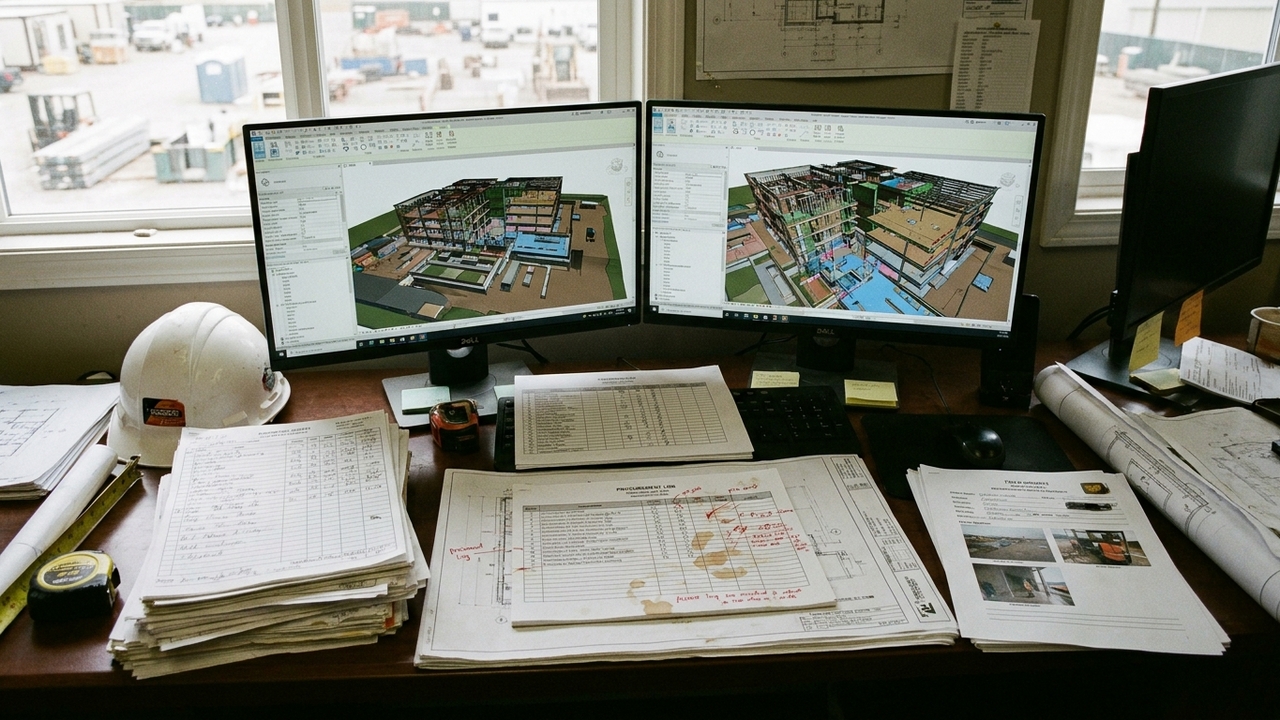
The core issue: construction teams often operate with multiple “sources of truth”
Most contractors have systems for modeling, estimating, procurement, and field reporting. The problem is not that those systems exist. The problem is that they often do not talk to each other in a disciplined way, and the human handoffs between them are inconsistent.
A model can change without updating takeoffs. A takeoff can be revised without updating procurement. Procurement can substitute materials without that information flowing back to coordination. Field conditions can force adjustments that never make it back into a central record. The project ends up potentially running with multiple parallel realities.
This is why “single source of truth” is often misunderstood. It does not mean there is one platform that magically contains everything. It means there is one governed set of decisions that the rest of the project aligns to, with a controlled process for change.
Connected workflows are the practical method of achieving that alignment.
If the project has four “truths,” it has no truth. Connected workflows aren’t fancy—they’re just a disciplined way to keep decisions from drifting.
What connected workflows mean in contractor terms
Connected workflows are not primarily a software stack. They are a set of agreements and habits that ensure critical information stays synchronized as it moves from one team to another.
In a connected workflow environment, coordination outputs are not isolated from estimating. Estimating is not isolated from procurement. Procurement is not isolated from fabrication. Fabrication is not isolated from field installation. Field installation feedback is not isolated from coordination updates. All shops are apprised of the adjustments made by the others.
The objective is not perfect automation. The objective is preventing drift. Drift is what turns small changes into major disruptions.
The “connection” therefore has two parts. The first is data connection—systems and tools that can share information. The second is process connection—rules that govern when and how information is updated, who approves changes, and what is considered current.
Without process connection, data connection becomes noise.
The connection isn’t the integration. The connection is the discipline: who updates what, when it’s approved, and what everyone agrees is current.
Where handoffs break most often (and why)
Construction handoffs fail in predictable places because those are the places where projects shift from one type of work to another.
1. Design and coordination to estimating
Estimating often happens early, under uncertainty. BIM coordination, if it starts later, can reveal that early assumptions were made from an incomplete knowledge of those conditions. If those updates do not flow into quantity reconciliation, the estimate becomes disconnected from what the job will actually build.
This disconnect can show up as material shortages, scope gaps, or inaccurate labor assumptions. It also affects bid confidence. Contractors either carry excessive contingency or bid too aggressively and pay later.
2. Estimating to procurement
Procurement requires stable quantities and clear specifications. When estimating updates do not flow cleanly into procurement, purchase orders are released based on outdated or partial information. The job then pays for change through returns, expediting, substitutions, and schedule churn.
3. Procurement to fabrication and field
Even when quantities are correct, procurement substitutions can create coordination conflicts if they are not reflected back into the model and install plan. Different dimensions, different connection requirements, or different lead times can disrupt sequence. If the field discovers those differences late, the resolution is usually expensive.
4. Field conditions back to the model and coordination record
Field conditions always matter, particularly in retrofit work, tight tolerance environments, and congested builds. When field adjustments are made without feeding the information back into a central system, the project loses the ability to coordinate effectively. Future work is planned against an outdated representation of reality.
This is where connected workflows matter most: they keep feedback loops alive and ensure broad awareness of changes.
Most failures happen at release points—buyout, fab release, close-in. If your handoffs are weak there, that’s where the job starts paying for it.
The cost categories connected workflows reduce
Connected workflows are often posed as “efficiency.” The more useful framing is as a source of cost avoidance and risk reduction. The cost categories impacted include:
- Rework and field modification: work performed twice or installed out of sequence due to mismatched information
- RFIs and coordination churn: questions that exist because decisions are not visible or consistent across teams
- Schedule compression: time lost to resequencing, expediting, and stacking trades to recover from avoidable delays
- Procurement waste: returns, reorders, and substitutions driven by outdated quantities or unclear specs
- Labor inefficiency: stop-and-start production caused by incomplete or inconsistent install information
- Quality impacts: rushed fixes and unplanned workarounds that create punch-list drag and warranty risk
These costs often appear as “project complexity” rather than as workflow failure, which is why they persist. Connected workflows help because they reduce the number of situations where teams are forced to improvise due to information drift.
Connected workflows don’t just save time. They prevent the expensive kind of time loss—rework, overtime, expediting, and the close-in chaos nobody budgets for.

What a connected workflow looks like in practice
Connected workflows are built from repeatable rhythms. The project does not need to be “high-tech.” It needs to be disciplined.
1. A defined change-management loop
Connected projects define how change is introduced and absorbed. Model changes are tracked. Quantity impacts are reconciled. Procurement impacts are reviewed. Field impacts are communicated.
Illustrative example: A project establishes a weekly change review for coordination-driven updates. Any routing change in critical zones triggers a quick impact check: what quantities shift, what purchase orders are affected, what fabrication releases are impacted, and what field sequence assumptions change. The change is then communicated in a structured way. The time spent is modest. The avoided disruption is significant.
2. Clear ownership and accountability at handoff points
Connected workflows fail when handoffs are treated as “someone else’s problem.” Successful projects define ownership at each transition point. Who owns the model update? Who owns quantity reconciliation? Who owns procurement alignment? Who owns communicating the impact to the field? Explicit definition of ownership minimizes drift.
3. Practical “single source of truth” definitions
Instead of attempting to centralize everything, connected projects define which artifacts are authoritative for which decisions. For example, the coordinated model may be authoritative for routing and clash resolution in critical zones, while a procurement log may be authoritative for approved material substitutions. The key is that authoritative sources are known by all relevant parties and kept aligned.
4. Structured outputs for field execution
Connected workflows do not assume that model access equals field clarity. They provide field-usable outputs: coordinated install views, updated material expectations, and clear statements of what changed. This reduces the gap between coordination intent and execution reality.
Connected workflows are just repeatable gates and rhythms. If the project can’t tell the field “here’s what changed and what it affects,” you’re going to get rework.
Minimal tech versus overkill: why discipline beats complexity
Many firms assume connected workflows require an advanced enterprise tech stack. In reality, most failures are not caused by tool limitations. They are caused by weak process discipline and unclear ownership.
A connected workflow can exist with modest technology if the project has strong habits: consistent naming, version control, clear change logs, and structured communication. Conversely, even the most advanced platforms will fail if people are not trained, standards are inconsistent, and parallel workflows continue.
The most reliable approach is to build connected workflows from the inside out: start with the handoff points where failures incur the most cost, define the process loop, then apply tools that make the loop easier to maintain.
You can’t buy your way out of drift. If the workflow is sloppy, the platform will be sloppy. Build the discipline first, then use tech to make it easier.
Conclusion: connected workflows reduce chaos by reducing drift
Coordination chaos is what happens when a project operates with multiple truths at once. It is rarely caused by one bad actor or one bad decision. It is caused by drift across handoffs: model changes that do not update quantities, procurement actions that do not update install intent, field adjustments that do not update coordination reality.
Connected workflows reduce chaos by making drift less likely. They create repeatable feedback loops, define ownership at handoff points, and keep decisions visible across teams. The payoff is practical: fewer late surprises, fewer avoidable RFIs, less rework disguised as “field adjustments,” and a project that can move forward with more confidence that everyone is building from the same assumptions.
That is not a technology trend. It is basic project control applied to the realities of modern coordination.
The goal is simple: stop letting the job run on different versions of reality. When you keep decisions connected, the field can focus on building—not fixing.
CONTACT US if you would like to talk about this with us.