
Although it seems to rapidly change everyday, Artificial Intelligence is now part of the construction conversation, whether project teams ask for it or not. It appears in software updates, sales calls, and internal discussions about how to “modernize” coordination. The problem is that AI is often conceived of in extremes—either as the momentum for a major leap in productivity or an inapplicable fad that construction professionals will struggle to integrate on the jobsite. Neither viewpoint helps a project team decide which tools to adopt, which to ignore, and which to test carefully.
A more useful conceptualization of AI’s utility in construction starts with analyzing its impact on coordination outcomes. When AI adds value in BIM and VDC today, it typically does so by reducing the time and effort required to move from “issue identified” to “buildable decision” while maintaining accuracy and accountability. When AI fails, it tends to fail in predictable ways: it produces output that looks polished but isn’t verified, it amplifies inconsistent inputs, or it introduces a new layer of workflow overhead that teams do not have time to maintain.
This article separates hype from practical application by centering the work itself. The focus is not on futuristic jobsite automation, but on areas where AI can strengthen coordination: clash triage, change awareness, documentation consistency, and information packaging that serves both field execution and project leadership.
Why the “AI will run the job” narrative misses the point
Many AI conversations in construction begin with the assumption that the technology should function like a superintendent or a project manager—absorbing context, anticipating constraints, and producing decisions. That is not how BIM coordination operates, and it is thus not how AI will function most effectively.
Construction coordination succeeds when it creates reliable, buildable clarity across trades under schedule pressure. It requires scope definition, sequencing awareness, tolerance management, and decisions that reflect how work products are actually installed. AI, at least in its current form, is not a substitute for those fundamentals. It does not possess the judgment derived from years of experience in the trade, nor does it bear responsibility for decisions that affect cost, schedule, or safety.
But AI can help in narrower and more practical scenarios. It can reduce repetitive work that slows teams down, help organize information at scale, and accelerate administrative coordination functions that consume disproportionate time. In other words, it functions best as a multiplier for disciplined processes rather than as a replacement for the judgment of experienced people.
AI is getting oversold the same way every “next big thing” gets oversold. The jobsite doesn’t care about a feature release. If a tool helps the team catch conflicts earlier or move decisions faster, it’s worth attention. If it just creates another dashboard and another login, it’s noise. But it will only be a matter of time before we really need to stop listening and start implementing.
The coordination problems AI can meaningfully improve
In BIM/VDC environments, the highest-cost problems are rarely the dramatic ones frequently featured in industry marketing. The problems that repeatedly create schedule and margin damage tend to be operational: too many issues, too little clarity, and decisions arriving late.
Clash detection illustrates these problems well. Most teams can generate clash reports; the more daunting tasks are managing volume, eliminating noise, identifying what is truly high-risk, and resolving issues without losing track of scope. Another recurring problem is model drift, where changes are made but downstream impacts are not recognized quickly enough to avoid installation disruption. Finally, coordination requires the production of a steady stream of documentation issues, meeting notes, action logs, and follow-ups. When required documentation output varies across projects and teams, performance measurement and accountability enforcement are jeopardized.
These are the areas where AI is already showing credible value – not by “solving” coordination, but by tightening the cycle time of coordination work and improving the consistency of how teams capture and communicate decisions.
The best coordination teams I’ve seen aren’t struggling because they can’t find clashes. They’re struggling because they’re fighting time—time to sort issues, discover true conflicts vs clash detection noise, time to get answers and responses, time to keep model changes from turning into field surprises. AI is only helpful if it buys back that time without creating new problems.
Where AI is actually working today in BIM/VDC
Across current BIM/VDC tools, the most defensible AI use cases share two characteristics. First, they apply to repeatable coordination tasks rather than subjective trade judgment. Second, their output can be reviewed quickly by an industry professional before it becomes a project decision.
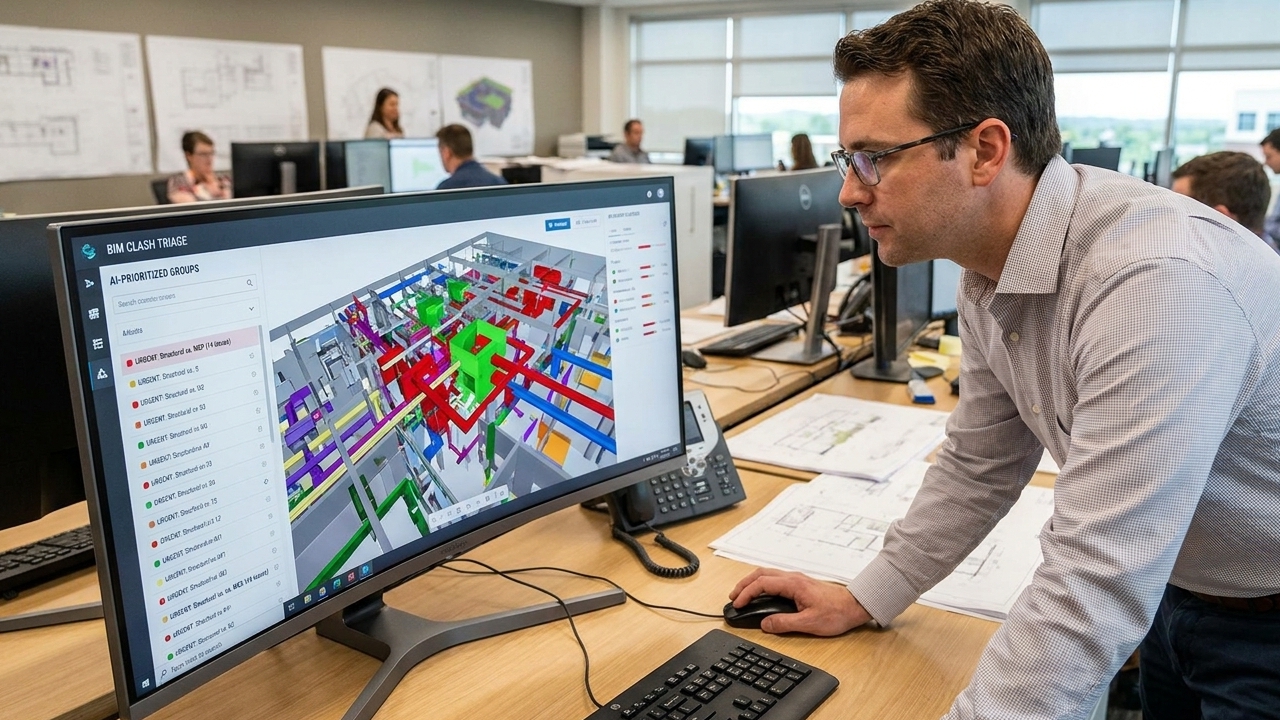
1. AI-assisted triage: reducing noise without losing real conflicts
Coordination teams often face a volume problem. A clash run can generate hundreds of conflicts, and the list is rarely “clean.” Many conflicts are duplicates caused by a single root condition. Others are technical clashes but not meaningful in the job’s sequence or tolerance context. Without efficient triage, coordination meetings turn into time-consuming sorting exercises instead of decision-making sessions.
AI can help by grouping clashes into clusters that reflect likely root causes, organizing them by location or system, and highlighting patterns such as repeated conflicts in high-density zones. This does not eliminate the need for a coordinator’s review, but it reduces the time spent turning raw outputs into an agenda the team can act on.
Illustrative example: A project runs weekly MEP clash detection and routinely produces several hundred conflicts. Instead of treating the output as a flat list, an AI layer groups conflicts by corridor segments and mechanical room zones, then collapses duplicates tied to the same routing constraint. The coordination team validates the groupings, and the meeting focuses on the few decisions that meaningfully affect the installation sequence and access.
2. Change awareness: turning version updates into actionable review
Model revisions are inevitable. The coordination risk is not that revisions occur, but that teams struggle to grasp what changed and what the change affected in a timely manner. In fast-moving preconstruction or late-stage coordination, a team may spend hours manually hunting through views to understand differences between model versions, particularly when the change creates secondary impacts across trades.
AI-assisted model comparison can reduce this friction. When it works well, it highlights changed elements, summarizes the nature of the changes, and points reviewers toward likely downstream conflicts. The value is not perfect automation; it is faster orientation and prioritization so humans can focus their attention where it matters.
Illustrative example: A late equipment substitution changes dimensions and connection points. The AI comparison flags the altered geometry, identifies likely clearance conflicts in adjacent runs, and generates a short change summary that helps the coordination team validate impacts before the issue becomes a field constraint.
3. Documentation support: standardizing the “coordination paperwork” that slows teams down
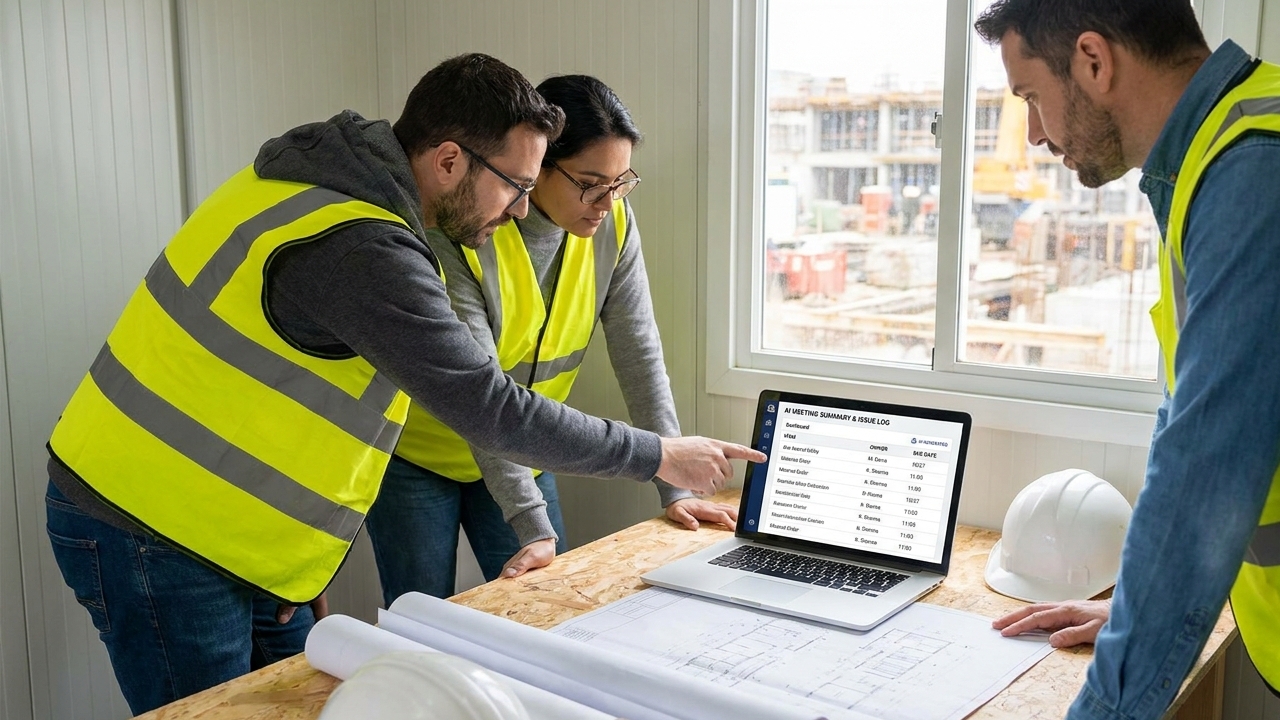
The unglamorous reality of coordination is that it produces constant documentation. Issues need consistent titles and tags. Action items need action-owners due dates. Meeting notes need to be captured clearly enough that decisions do not get lost in follow-up. When this work is produced inconsistently, it becomes difficult to track performance or even confirm whether issues are truly resolved.
AI can reduce the time required to convert rough notes into structured documentation. It can draft issue descriptions, standardize naming conventions, and produce meeting summaries that follow a consistent format. These functions result in significant time savings by reducing manual effort without requiring AI to make technical decisions.
This is not to suggest that templates and review standards no longer matter. If the organization lacks a consistent issue taxonomy or shared format for action items, AI output will either be unreliable or will impose a structure that does not match how the team actually coordinates.
Illustrative example: A coordination team adopts a standardized issue format (location, system, conflict description, decision required, owner, due date). AI is used to draft the first versions of issue notes and meeting recaps from screenshots and brief coordinator input. A human reviews for technical accuracy and clarity, but the documentation effort drops materially because the base structure is produced quickly and consistently.
If AI makes it faster to answer, “What did we decide?” that’s real value. Jobs don’t fall apart because the information doesn’t exist. They fall apart because the information is hard to find, hard to trust, or gets stuck in someone’s inbox. See Autodesk’s CEO Andrew Anagnost’s plea for Gov to help accelerate AI adoption for construction.
Where AI is still mostly hype in BIM/VDC
The less credible claims of AI applicability tend to share a different pattern. They promise “autonomous” decision-making without showing how decisions are verified; they assume consistent input quality that does not exist on most projects, or they understate the adoption burden of adding another tool to an already fragmented workflow.
One persistent misconception is that AI can compensate for weak coordination fundamentals. It cannot. AI systems depend on inputs—model organization, naming standards, issue tagging, and version control discipline. If inputs are inconsistent, output quality declines, even if the interface remains polished. The risk is that teams may trust the polish and miss the inaccuracies until they become field problems.
Another common failure is tool stacking. If an AI layer is introduced without removing or simplifying other processes, coordination teams may find themselves maintaining multiple systems in parallel that are rendering duplicative or contradictory outputs. That quickly creates overhead, and adoption declines, especially when field teams do not see a direct benefit.
A final source of failure is unclear ownership. AI tools require process ownership: templates, rules, review standards, and feedback loops. Without that, quality drifts, output becomes inconsistent, and trust in automation erodes.
If a tool helps a coordinator get to the real conflicts faster, that’s a win. If it claims it can coordinate the job by itself, it’s not living in the real world. The field will always be the truth test. I like BirdTools 5.0, which allows real-time clash detection inside Revit – the authoring tool – instead of other clash software.
What practical evaluation looks like for project teams and leadership
AI decisions in construction are often framed as technology or software decisions. In reality, they are workflow decisions. The most useful evaluation approach is to ask what part of the coordination work is being improved and how success will be measured.
For coordination teams, useful assessment metrics include time spent on triage, time to prepare meeting agendas, time from issue identification to assignment, and the rate of reopened issues (a quality signal). For leadership, the measures tend to be indirect but still meaningful: fewer late-stage clashes, fewer coordination-driven change orders, reduced schedule variability tied to MEP and above-ceiling work, and a more predictable handoff from preconstruction to execution.
AI value typically shows up as fewer fires and fewer recoveries. That does not make it less impactful; it simply means evaluation should focus on cycle time and consistency rather than dramatic “before/after” claims.
A controlled approach to piloting AI in BIM
Because AI tools vary widely in quality and fit, the most responsible approach is a controlled pilot tied to a specific workflow. The goal of a pilot is not to prove that AI is the future; it is to measure whether the tool reduces friction and streamlines processes without introducing new failure points.
A practical pilot scope usually targets repeatable tasks with clear verification. Examples include agenda creation and meeting summaries, issue formatting and tagging, change summary drafts between model versions, or clash list grouping for triage. These areas offer measurable time savings and lower technical risk, provided human review remains alert and consistent.
Illustrative example: A contractor pilots AI meeting documentation on a single project. In early weeks, the summaries are fast but inconsistent in action-item clarity. The team adjusts the template so each action includes an owner, due date, and model reference. After the adjustment, the output becomes consistent, the coordination team spends less time on documentation, and follow-ups become clearer. The pilot succeeds not because AI “understands construction,” but because the workflow is structured and the output is reviewed.
I don’t care if it’s called AI. I care if it reduces rework and makes coordination more predictable. If the team can’t verify the output quickly, it shouldn’t drive decisions. Construction is expensive enough without adding “confidently wrong” to the mix.
What the next 12–24 months likely brings
In the near term, AI’s strongest contribution to BIM/VDC will remain in coordination rather than autonomous decision-making. The most practical improvements will continue to center around issue management, version awareness, documentation consistency, and better packaging of information for decision-makers.
As reality capture becomes more integrated into project workflows, AI may also become more useful for identifying discrepancies between model intent and field reality, particularly in progress validation and deviation detection. Even then, the fundamental requirement will remain the same: outputs must be verifiable, and decision-making responsibility must remain with qualified project leaders.
The day AI makes authoring and automation easier for the average BIM user, you’ll feel it. Not in a press release—in production. If it helps teams build repeatable workflows faster and keep models cleaner under change, that’s where the payoff will show up first. I’ve always thought the authoring software should do a better job at this natively – we just aren’t getting there fast enough.
Conclusion: AI is useful when it tightens coordination cycles without reducing accuracy
The clearest separation between hype and value is not found in feature lists. It is found in whether AI reduces the time and effort required to coordinate, decide, and execute without increasing risk. AI is most functional today when it improves triage, highlights meaningful change, and reduces documentation drag. It becomes risky when it is positioned as a substitute for trade judgment, or when it is deployed into workflows that lack consistent structure.
Ultimately, AI can not replace the fundamentals of coordination. When coordination inputs are disciplined and workflows are consistent, AI can accelerate work and reduce overhead. When inputs are inconsistent and workflows are fragmented, AI tends to amplify the underlying problems and even create new ones.
AI will earn its place in BIM the same way every tool earns its place in construction: it will prove it can help teams build better with fewer surprises. Until then, keep your standards tight, keep your coordination disciplined, and treat AI like any other tool—use it where it works, and don’t let it create new chaos.
CONTACT US if you would like to talk about this with us.